China Doubles Down on Coal-Fired Power, With Record Plant Capacity Planned
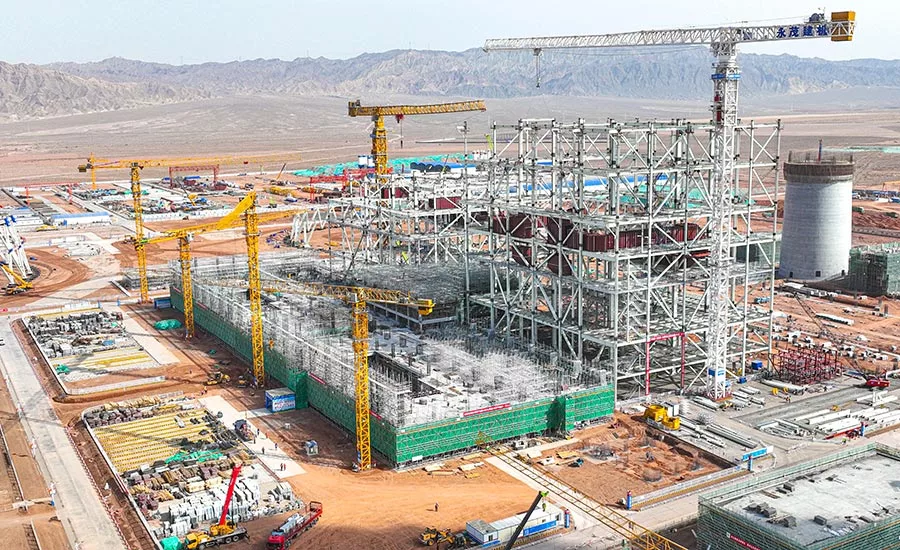
Steel structure cooling tower construction is seen at a 1-GW coal-fired plant unit expansion in the city of Zhangye in China's Gansu province, as of early March.
Photo by Cfoto/DDP via ZUMA Press
China is doubling down on more coal-fired power after a decade-long push toward renewable energy, with officials revealing their approval of a huge amount of new capacity ordered up last year. Construction of plants to produce an estimated 94.5 GW of power from coal that began in 2024 represents the highest level of new or resumed projects using the fuel source since 2015—sharply contrasting the steady decline seen between 2015 and 2021.
While China remains the world's largest investor in solar and wind power, government focus in favor of coal power is evident in slowed retirement of aging plants, with closures falling from 13 GW in 2020 to just 2.5 GW last year, according to national statistics, says research by San Francisco-based market research firm Global Energy Monitor and Helsinki-based think tank Center for Research on Energy and Clean Air.
Most of the new projects are megaplants with capacities greater than 1 GW sited in Shandong and Inner Mongolia, under development by state-owned giants such as China Energy Investment Corp, and Huaneng Group. The Guangdong Taishan project, using ultra-supercritical technology, is among the largest, with a capacity exceeding 1.2 GW. Foreign companies, while are barred from directly owning or constructing power projects in China, are supplying technology and expertise. Firms such as GE, Siemens and Mitsubishi have provided turbines, automation systems and emission control technologies.
The policy shift came after a decade in which President Xi Jinping touted his efforts to push China's more climate-friendly agenda after the U.S. withdrew from the Paris Agreement during President Donald Trump’s first term. But economic slowdown, rising unemployment, fear of greater job losses if coal mining is restricted and energy security needs have forced China policy makers to make the shift, observers say.
Coal mining and power businesses are closely linked in China, says Christine Shearer, Global Energy Monitor project manager, adding that more than three-quarters of the country's newly approved coal power projects in 2024 were financed by mining firms or energy groups with mining operations. These are also state-owned companies with significant influence on policymaking that are backed by powerful trade unions, she adds.
The surge in new power plant construction was preceded by a major hike in coal mining permits mostly in major coal-producing provinces such as Xinjiang, Inner Mongolia, Shaanxi and Gansu. “The surge in construction of new power plants was preceded by a significant increase in coal mining permits of more than 200 GW of coal-fired power capacity,” adds Shearer.
These interest groups are "moving quickly to secure growth before policy space narrows" under China's 2030 and 2060 climate targets, says Qi Qin, a China analyst at the Helsinki-based think tank Center for Research on Energy and Clean Air, adding that local and provincial governments justify expansion of coal capacity as essential for energy security and local economic growth.
Looking for quick answers on construction and engineering topics?
Try Ask ENR, our new smart AI search tool.
Ask ENR →
“Although some authorities argue that more coal power is necessary to 'firm up' the country’s power system, a more flexible and efficient grid could reduce the need for additional coal capacity,” Shearer notes. The expansion threatens to derail President Xi Jinping’s pledge to peak emissions before 2030. "From an energy system perspective, additional coal power capacity is not necessary if China continues to improve grid efficiency and expand renewable energy at the current pace," adds Qi.
Coal and Climate Change
Whether China’s new commitment to coal power undermines global efforts to combat climate change, or is a temporary measure to stabilize a struggling economy depends not only on its electricity generation in coming years but also on the turmoil in global energy markets.
The resurgence of coal raises questions about the future of China's renewable energy projects and concerns about whether the world's largest emitter of carbon dioxide is adopting modern pollution control technologies to minimize emissions.
The country added 356 GW of wind and solar capacity by the end of 2024—nearly equivalent to the total installed capacity in the U.S. The central government remains committed to expanding this as well, targeting 1,200 GW of combined capacity by 2030.
Critics argue that China's dual investment in both coal and renewables creates a conflicting dynamic, undermining its efforts to reduce emissions.
“China is deploying ultra-supercritical and supercritical coal technology, which can operate at higher temperatures and pressures (above 600°C and 30 MPa) to improve thermal efficiency and reduce coal consumption,” Clare Richardson-Barlow, a non-resident fellow at the National Bureau of Asian Research, told ENR.
The country has also adopted flue gas desulfurization and selective catalytic reduction systems to cut sulfur dioxide and nitrogen oxide emissions, but carbon capture and storage technology remains in its infancy, with fewer than 10 large-scale projects in operation, she said. China's mercury emission standards are also significantly more lenient than international norms, with no dedicated reduction technologies in place.
However, there are signs of a potential policy adjustment. Reports indicate a decline of more than 30% in new coal permits issued in early 2024 compared to late 2023, which analysts suggest may reflect growing concerns about grid overcapacity and stability. Yet the expectation remains that coal power capacity will continue to expand in the near term. China now accounts for 93% of new coal power construction worldwide, as reported by Global Energy Monitor and the Center for Research on Energy and Clean Air. Geopolitical instability and energy security concerns—exacerbated by the Ukraine conflict—have reinforced its commitment to domestic energy production.
US Now Follow China in Reviving Coal Power
China's push to expand coal-fired power generation also appears to have prompted the U.S. to seek a similar effort, according to a Donald Trump social media post late on March 17 that said he was "authorizing my Administration to immediately begin producing Energy with BEAUTIFUL, CLEAN COAL."
UPDATE: Trump on April 8 signed four executive orders directing federal steps to boost the coal sector, remove market barriers such as environmental rules and take "long overdue" action to improve U.S. grid reliability. These include deeming coal as a critical mineral, urging its use to power data centers, ending regulations and policies that deter US coal for electricity generation and ramping up US Justice Dept efforts to investigate state policies considered to discriminate against coal energy sourcing. The edict also pushes for technology development and more exports through international offtake agreements.
Coal now makes up about 15% of American power generation, down from more than 50% in 2000, says the U.S. Energy Information Administration. Utilities are set to close 61 GW of coal-fired power plants between 2025 and 2030, says a Platt's analysis. Coal plants across Colorado are expected to be retired by the end of 2030 and major multi-state power providers such as Tennessee Valley Authority are proceeding to replace coal fired generation with natural gas plants. But others such as Georgia Power, Duke Power and PacifiCorp have recently announced plans to delay facility retirements, citing AI and data center-generated power needs. The latter's 2035 resource plan just submitted to state regulators has removed 2031 and 2032 retirement dates for two operating plants in Utah.
The U.S. Energy Dept said $200 billion in low-cost, long-term financing earmarked for energy infrastructure through its Loan Program Office Energy Infrastructure Reinvestment Program "can support a wide range of projects available for coal energy investments," including energy infrastructure upgrade or replacement to restart operations or improve production efficiency.
"The coal fleet is a reliable, affordable, secure and resilient source of electricity," said Michelle Bloodworth, president and CEO of America's Power, a coal industry advocacy group who urges an end to plant retirements.
But "studies show that 99% of U.S. coal plants are more expensive to run than it would be to replace them with wind, solar or other energy sources," said Ted Kelly, director and lead counsel of US clean energy for the Environmental Defense Fund. "Coal use has declined because of the high cost of operating coal plants, and no executive orders will change that market reality. Increased use of coal will only be possible through subsidies."
Rob Gramlich, president of Grid Strategies, a Washington energy consultant said in a social media post that the federal government "has no authority to prevent coal plant retirements or force an owner to lose money by running the plant." He added: "Natural gas fracking killed coal power in the US and neither this nor any previous administration is banning fracking."
U.S. Interior Secretary Doug Burgum speculated in March at the Houston energy sector conference CERAWeek by S&P Global that the administration could invoke emergency authority to halt further coal-fired plant retirements and reopen closed facilities. Observers note major constraints, including high costs, to restore significant coal-fired power—pointing to needed upgrades of facilities using old operating technology and new pollution compliance rules for air emissions and coal ash disposal enacted under the Biden Administration. Montana's Colstrip power plant, said to emit a high level of airborne pollutants in the U.S., but claiming economic hardship, now has applied for a two-year exemption from requirements under a new loophole announced by the U.S. Environmental Protection Agency.
Others point to new cost unknowns stemming from just invoked tariffs that could impact energy use by hurting the economy. “Economic growth and energy consumption are pretty closely linked,” Aurora Energy Research managing director Oliver Kerr said in a Heatmap News report. “An economic slowdown tends to result in less demand for power overall." Coal supply for sector use could also be hurt, Chris Hamilton, president of the West Virginia Coal Association, told local media, noting potential for reduced state output with the added 15% levy on China coal imports. The state exports abour 6 million tons per year to that country.
Richardson-Barlow noted that "the U.S. retreat from international climate commitments has had a knock-on effect, potentially weakening global pressure on China to reduce emissions." The shifting dynamics also are influencing developing nations like India, Indonesia and Vietnam, which continue to expand coal capacity despite climate pledges.
Vickie Patton, general counsel. of the Environmental Defense Fund, said “dictating the use of more coal would essentially be a huge tax on the American people, increasing electricity costs and health care costs ... and take the U.S. in the wrong direction.”