ENR 2026 Top 500 Design Firms: AI Boom Buoys Design Revenue
April 22, 2026
ENR 2026 Top 500 Design Firms: AI Boom Buoys Design Revenue
April 22, 2026

Related Links:
ENR 2026 Top 500 Design Firm Rankings
2026 Top 500 Design Firms | Full PDF
(Subscription Required)
With some economists forecasting that an expected $1.75 trillion in AI-related infrastructure spending will drive U.S. economic growth well into 2027, the phrase “a rising tide lifts all boats” rings true—at least for participants on this year’s Top 500 Design Firms list. Overall, firms clinched a 7.4% increase in revenue last year to $158.7 billion. Yet while some firms say they are swimming in a sea of resource-intensive data center projects, other firms report projects drowning in uncertainty amid intensifying competition over building resources, speed-to-market timelines and shifting international conflicts and policy changes.
In an interview with CNBC’s “Mad Money” host Jim Cramer last month, Jacobs CEO Bob Pragada said the firm’s data center business, which jumped 62.2%, surging its project pipeline by 500%, was a “real growth engine” for the company. Such growth is further reflected in the global services firm’s rise to No. 1 on the Top 500 Design Firms list this year, with last year’s top firm, AECOM, sliding to No. 2. In comments to ENR, Pragada says the firm’s clients are navigating a “convergence of challenges,” from the “rapid, large-scale buildout of (artificial intelligence) infrastructure, economic and geopolitical disruption to rising global demand for new drugs and therapies.”

Surging Demand
In the face of such challenges, Pragada says the firm’s chief responsibility remains clear: “Continue to innovate while navigating constant change.” Pragada adds that such a strategy “reflects what we see clients across our industry needing: a trusted advisor for end-to-end solutions, from planning and shaping their capital programs through delivery of their most complex projects and assets.”
Arup Americas Managing Director Scott Russell says the firm, ranked No. 55, is committed to tackling market complexity by “leaning on our expertise and innovation” while still upholding its values of “responsible growth and stewardship” to meet demand. At Introba Inc., President and CEO Matthew Cummings says innovation calls for “managing the intersection of talent and transformation.”
Cummings adds, “Clients are asking for more innovation faster, at a greater value. We need people with strong technical skills who can collaborate comfortably across disciplines and on projects that are growing in complexity.” At the same time, he says technology is changing the design and delivery process, “requiring continuous learning and a willingness to evolve how we get work done.”
In this way, amid ongoing labor shortages, LJB Inc. CEO Rod J. Sommer says technology integration has become a matter of survival as firms fight to keep projects afloat in an increasingly competitive market. The Ohio-based firm is ranked No. 287.
“The industry is being pushed to do more with fewer people, making the integration of AI and automation essential,” says Sommer. “The challenge [for the industry] is moving quickly enough to stay competitive while ensuring those investments deliver real value and sustain margins,” he says.
Energizing AI

At a global scale, research consulting firm McKinsey estimates that AI infrastructure spending will reach $6.7 trillion by 2030, fueled by data center project hyperscalers such as Amazon, Alphabet, Apple, Meta and Microsoft. Considering that there isn’t “much [else] driving the U.S. economy forward right now,” Associated Builders and Contractors Chief Economist Anirban Basu assessed that data center work is one of few current opportunities for economic growth across the construction sector.
Looking for quick answers on construction and engineering topics?
Try Ask ENR, our new smart AI search tool.
Ask ENR →

AG&E CEO Sanjay Agrawal says the No. 356-ranked firm wins work through its vertically integrated approach, combining traditional systems engineering and operations research work with downstream specialty services like steel detailing and precast engineering—both critical components to data centers. “This integration gives our clients the ability to shorten construction schedules, making us a preferred partner,” says Agrawal, explaining that, as a result, AG&E has become one of the largest structural engineering firms in the U.S. to focus on data centers.
For Ulteig Engineers, ranked No. 87, increased demand for data centers has “changed the tempo” of its portfolio of work as resources shift to also meet a surge in demand resources to power data centers.

“As electric utility and renewable energy clients respond to rapid load growth, resources are shifting to grid upgrades, interconnections, new generation and system planning,” says President and CEO Doug Jaeger. “The surge creates opportunity while tightening capacity, especially for specialized talent and teams that can move quickly without sacrificing quality.”
Jaeger adds that such a shift has also changed how the work crystallizes in the firm’s markets. He notes, “Unlike traditional utility capital investment programs planned over longer horizons, data center work can arrive with more urgency and less certainty around scope and timing. That volatility challenges resource planning and execution discipline.”
Jaeger believes that artificial intelligence infrastructure projects are also “breaking the traditional power demand curve,” creating “fast, volatile loads the grid was never designed to accommodate.”
As a result, “capacity and schedule certainty is often deciding factor for siting and expansion,” says Dave Sobeck of the No. 49-ranked Carollo Engineers. “It’s pushing earlier coordination among owners, utilities, and economic development teams to avoid commitments that outpace infrastructure realities.”
Jaeger says that design firms can win by being a “steady partner.” He adds, “Clients value teams that bring structure early, clarify constraints and integrate solutions across the full lifecycle,” explaining that Ulteig Engineers has been focused on megaprojects “where renewables and storage are co-located with data centers and other large-load projects,” because that is where he believes the “long-term infrastructure buildout is headed and integrated execution matters most.”
Behind the Numbers
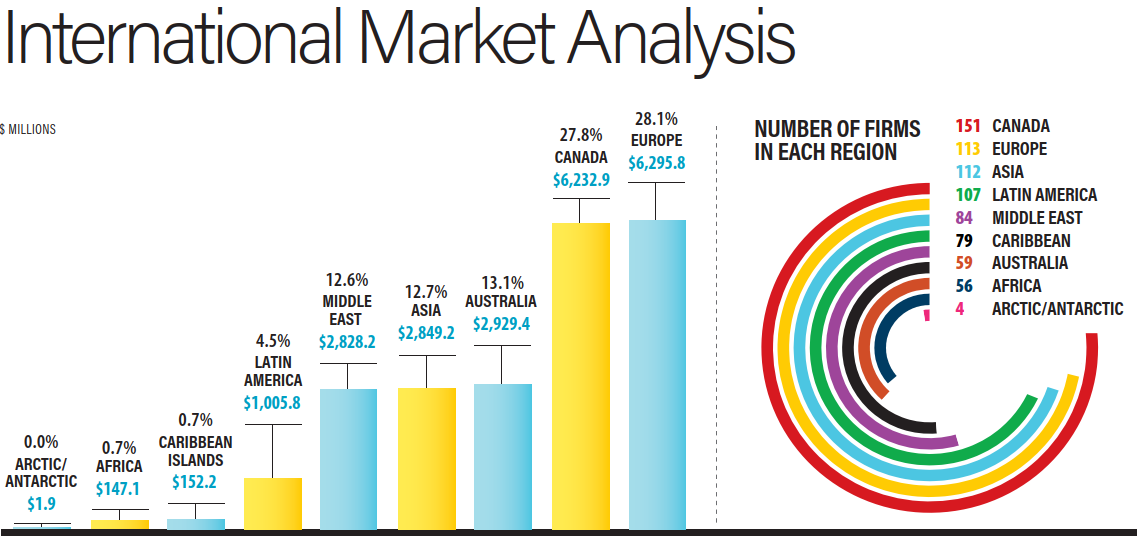
Domestic design revenue for ENR’s Top 500 Design Firms increased 8.1% last year to $136.3 billion and international revenue rose 3.2% to $22.4 billion. Both increases are in line with the growth seen between 2023 and 2024, according to data submitted to ENR.
Of the 475 design firms that filed surveys this year and last, 83.2% reported an increase in revenue. The Top 10 design firms accounted for 32.2% of total Top 500 design revenue. Both readings are also in line with last year’s survey results.
Median firm revenue rose to $103.2 million in 2025, up 6.4% from 2024. However, median revenue for firms self-identifying as architects shrank notably, down 13.9% to $58.7 million.

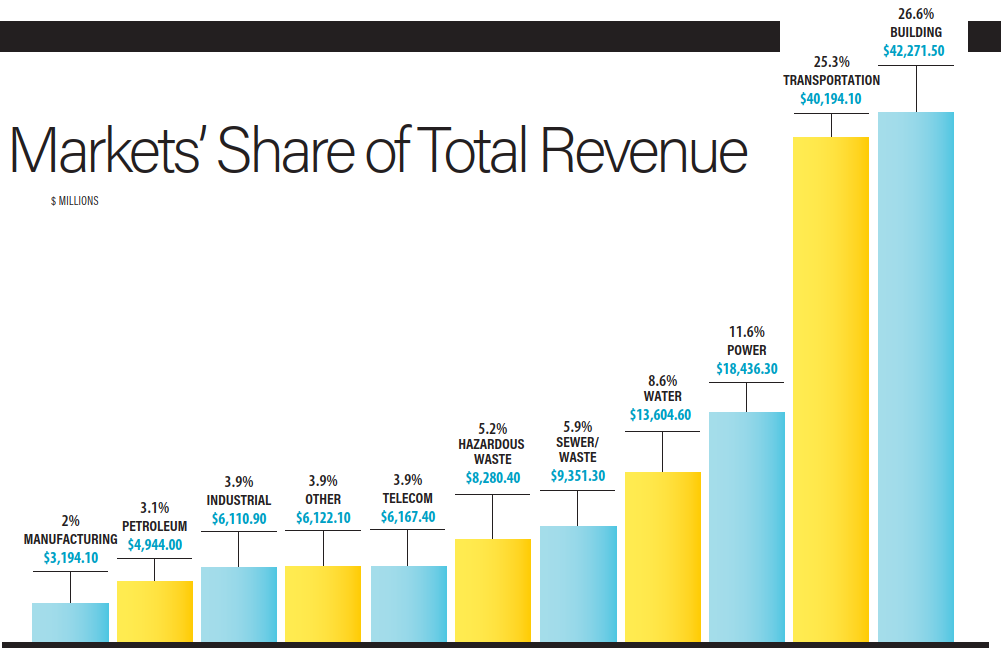
The telecommunications market, driven by data centers, continued to surge in 2025, rising 31.3% between 2024 and 2025. Market revenue rose just under 87% between 2023 and 2025. The power market is the only other market to show double digit growth, rising 14.6%, although the water supply market rose 9.9%.
Revenue from the oil and gas market continued its multi-year slide, dropping 18.6% between 2024 and 2025. Revenue in that market has fallen 40.2% between 2023 and 2025. Revenue in manufacturing also fell by double digits, dropping 17%. Both the hazardous waste (down 8%) and industrial process (down 5.2%) markets also contracted.
In the American Institute of Architects January 2026 Consensus Forecast, a 12–18 month forecast of nonresidential building construction business conditions, its panel of forecasters—including ABC, S&P Global Market Intelligence and Dodge Construction Network, among others—concluded that the U.S. economy is plagued by “uncertainty and imbalance.” In its published analysis, the panel writes that economic “uncertainty has been caused by longer-term impacts of tariffs, immigration policy and federal government spending.” Whereas imbalanced sector growth, “mostly related to investment in artificial intelligence,” has buoyed the stock market and the overall economy. The panel adds, “Some economic analysis suggests that AI-related spending in the U.S. has accounted for over half of all economic growth recently.” Yet “only a relatively small share of the population has benefited from the modest growth the economy has seen in recent years,” according to the panel. As a result, the panel says consumer confidence scores dropped to 54.9 in November 2025 from 79.6 in December 2024.
Research Centers | By Jonathan Keller

Rendering courtesy of Treanor
Treanor (No. 403), along with KPMB Architects, provided design services on the Temerty Discovery Centre project in Toronto. The 385,000-sq-ft mental health research center will be a hybrid mass timber structure with cross-laminated timber integrated into the concrete composite floor systems. The floor assembly uses a BubbleLAM bubble deck system attached to the CLT through kerf cuts and shear keys. The building will be heated and cooled by a geothermal field. The team is pursuing LEED V4 Platinum and Tier 3 Toronto Green standards.
Shifting Policies
Navigating continued volatility in the commercial property market is a challenge, says Omid Nakhaei, Arup’s Americas property leader. However, he says the firm is seeing a strong demand return for high-quality Class A office space across the U.S. and Canada, driven in part by return‑to‑office policies from financial and corporate occupiers. “Class B and C assets continue to struggle,” says Nakhaei. “At the same time, we’re seeing a broader shift toward repositioning and reinvention. We are seeing increased activity in office‑to‑residential conversions, adaptive reuse and alternative uses such as life sciences, data centers and mixed‑use developments, often supported by evolving building codes and public‑sector incentives.”

“While affordability and housing supply remain acute challenges … these pressures are also creating opportunities.”
Omid Nakhaei, Property Leader, Arup
He adds, “While affordability and housing supply remain acute challenges across North America, these pressures are also creating opportunities for innovation, particularly at the intersection of policy, sustainability and new construction typologies.” For the broader industry, Nakhaei says the challenge is “not simply responding to market uncertainty but helping our clients and partners unlock value from existing assets while preparing for the next cycle of growth.”
Top 500 firms say shifting policies at a federal level are also creating opportunities for deft firms to innovate amid ebbs and flows in market sectors.
“Firms must remain highly adaptable and proactive as continued cost sensitivity and uncertainty are seen across markets,” says WSB COO Jon Chiglo. The firm is ranked No. 106. Chiglo adds, “While inflation, fuel prices and funding variability can be unpredictable, firms who are more conscientious when developing project budgets, building contingencies and identifying potential cost drivers early will reduce risk for their clients and drive more success.”
Chiglo says the firm has intentionally built its operations to “remain nimble and adaptable” to federal regulation changes and shifts in permitting requirements. “Our team actively monitors regulatory changes and proactively adjusts project approaches to support efficient design and approval processes,” he says.
CO Architects, ranked No. 293, says it has seen a noticeable downturn in its higher education work, potentially tied to increased federal scrutiny over programs and operations while college administrators address significant changes in federal funding and reimbursement. Similarly, Garver, ranked No. 85, reports “large swings in government funding and revenues for public infrastructure” appear to be slowing after recent highs under the Biden administration.

“Firms must remain highly adaptable and proactive as continued cost sensitivity and uncertainty are seen across markets.”
Jon Chiglo, COO, WSB
Meanwhile, CO Architects Managing Principal Jenna Knudsen says “health care continues to see consolidation of health systems and acquisitions of non-health care buildings, creating opportunities for evaluation of existing campuses and potential renovation or replacement projects in the future.”
Terracon Senior Vice President of Client Development Don Dracon says “more clients are engaging with us about supporting their nuclear initiatives,” given a recent congressional push for nuclear power and “changes to licensing policies, funding opportunities and support from some state legislatures.”
Dracon adds that Terracon, ranked No. 19, is also experiencing a “substantial increase in need for support” for site identification, design and construction tied to data center expansion.
Woolpert’s Executive Vice President of Infrastructure, Bryan Dickerson, predicts that federal regulatory changes around permitting are “likely to introduce more variability rather than uniformly faster project timelines.” For the firm, ranked at No. 36, “the more meaningful shift will be in how projects are delivered, not just how quickly permits are issued,” with some owners moving from sequential, stage‑gated approaches to parallel delivery models. He adds, “projects must be designed for adaptability, not just compliance.”
Reevaluating Owners’ Needs
Ultimately, the most successful design firms won’t just navigate permitting more effectively, “they’ll rethink how projects are conceived and delivered, using integrated [architecture, engineering, geospatial] capabilities anchored in geospatial intelligence to manage complexity from the outset,” says Dickerson. For many Top 500 firms, such a process requires a reassessment of the owners’ needs and project goals.
“In response to shifting funding sources, interest rate volatility and broader economic pressures, many clients appear to be approaching decisions more cautiously, with a focus on planning efforts setting the table for future initiatives,” says Tim Williams, Managing Partner of ZGF’s Wash-

“The more meaningful shift will be in how projects are delivered, not just how quickly permits are issued.”
Bryan Dickerson, EVP, Woolpert
ington, D.C., and New York offices. The firm is ranked No. 146. Williams says such factors have “only been compounded by geopolitical instability, which may quickly create downstream effects on material costs, inflation and overall project feasibility.”
In effect, WSP’s U.S. President, Joe Sczurko, says the firm is having increased conversations around asset optimization. He adds, “Owners are becoming very conscious about lifecycle costs, opportunities to extend the life of existing assets and how predictive analytics, including modeling and AI tools, can improve decisions around build, maintain, repair and replace.”
Sczurko says the firm, ranked No. 4, is working “more actively” with clients in the design phase to “determine how assets will perform over time, and how they can be operated during the asset’s life with a high degree of flexibility.”
Sczurko adds that WSP sees owners wanting engineers and construction advisers to be more forward-looking to incorporate future operating conditions during planning and design.
“It’s no longer a question of whether an asset can be constructed,” he says. “Owners want confidence that what they build will remain reliable, compliant and affordable as climate conditions, regulations, operating demands and operations vs. capital funding constraints evolve.”
Wastewater | By Jonathan Keller

Photo credit Watercare Services Limited, courtesy of Jacobs
After more than a decade of activity, the team working on Auckland, New Zealand’s massive Central Interceptor wastewater tunnel project can literally see the light at the end of the tunnel.
Designed to reduce wet weather overflows into Waitematā and Manukau Harbors by 80%, the 16.2-km, 4.5-m-dia tunnel is in some places 110 m deep. The tunnel doubles as a massive underground reservoir, with a storage capacity of over 200,000-cu-m, or 80 Olympic-sized swimming pools. It will operate by gravity flow, sloping at a gradient of 1:1000 so wastewater can flow downhill to the final destination at Māngere Wastewater Treatment Plant. The lining of the tunnel will be composed of more than 10,000 segment rings, with each ring weighing about 18 tonnes.
Jacobs (No. 1) started as the design lead on the $991-million project in 2014, before adding construction management and design support roles once construction began in 2019. The firm says that Auckland’s complex geology posed a significant challenge. “[The] main challenges involve managing risks from an active monogenetic volcanic field, significant slope instability and engineering difficulties within weak, variable soils such as East Coast Bays Formation,” the firm says. Thorough ground investigation allowed the team to mitigate most of the risks, but the team still had to drill 15 m below a stretch of Manukau Harbor. The tunnel also had to be integrated into a live wastewater network without disrupting essential services.
In addition to the main tunnel, project scope includes two pipe-jacked sewers totalling 4.3 km in length and 12 m to 70 m deep, 19 drop shafts and access shafts, connecting sewers, chambers, control facilities and air treatment facilities as well as a wastewater pumping station with dual cell diaphragm wall.
The southern section commenced operation in February 2025, with the northern section due to be ready to commission in mid-2026. The construction team is a Ghella-Abergeldie Joint Venture.
Increasing Project Sustainability
Amid climate change pressures pushing infrastructure project owners to shore up resiliency, “balancing resilience, sustainability and cost requires deeper, more strategic conversations with owners about how they budget for infrastructure and how climate change is reshaping both the solutions available and the associated costs,” says Heapy CEO Mark Brumfield. The firm is ranked No. 354.
Brumfield adds, “As climate pressures intensify, the price of resilient and sustainable infrastructure is increasing but so are the long‑term costs of inaction. When we look holistically at utility expenses, insurance premiums and the financial impact of extended downtime, it becomes clear that investing more upfront can offset significantly higher long‑term costs.”

“The price of resilient and sustainable infrastructure is increasing but so are the long‑term costs of inaction.”
Mark Brumfield, CEO, Heapy
Treanor Director of Sustainability Laura Pastine says the No. 403-ranked firm is developing its own firm-wide baselines to ensure its projects can endure through a long life in their specific climate zones.
“Regardless if a project is seeking a certification or not, we know buildings currently have a large burden to perform well over time,” says Pastine. “We spend a lot of time with facilities teams to address operations and maintenance. The teams who care for buildings over time have a huge impact if design intent is carried out in day-to-day operations. Building in opportunities to collect and review building performance data is crucial to confirming projects are performing as designed.”
For SSOE Group’s industrial and advanced technology clients, COO Matt Oberts says “resilience and sustainability translate directly into facility uptime, energy cost management, and future-proofing capital investments.” The firm is ranked at No. 103.
Oberts adds that the firm is employing several key design solutions to balance sustainability and resiliency pressures against costs, including modular and scalable utility infrastructure, integrated energy modeling and heat recovery, resilient site and building envelope design, and digital twin and data-driven design.
“This approach reflects a broader shift in the AEC industry away from sustainability as an add-on toward sustainability as performance,” says Oberts.
Water Resilience | By Jonathan Keller

Image courtesy of Michael Baker International
Michael Baker International (No. 28) is prime engineer on the Columbia Resilient Water Supply Project in Columbia, S.C. With the project located in a historically registered park, this early architectural rendering was part of the consultation process to assure partners the structural aesthetics being incorporated into the design would match with the existing historic structures.
Revaluating Firm Resources
Top 500 firms say they are also evaluating their internal needs. Labor resources remain a top priority, but firms say they are also looking for technology tools to complement the meet market demands.

Ennead is architect on video technology platform bilibili's Shanghai headquarters. The over 770,000-sq-m campus is divided in zones with buildings shaped as “mushrooms” or “bilis”, that taper to their supporting stems. Completion of the campus is scheduled for 2027.
Photo courtesy of Ennead Architects
“The surge in data center work hasn’t affected how or where we win work as much as it has affected the capacities of the talented contractors/subcontractors that we rely upon to install the work and the lead times of critical equipment as well,” says TLC Engineering Solutions CEO Michael P. Sheerin. “We have been enlisted to commission some complex data center projects as a backstop to the accelerated timelines of these projects and the capacities of other teams, and we are happy to help out.” The firm is ranked at No. 197.
Overall, firms say technology has generally helped them make smarter decisions earlier.
“From the earliest design conversations, our design teams work alongside AI design assistants that aggregate research, reconcile evolving client decisions, flag program conflicts before they compound, and validate design moves against code and benchmarks in real time,” says Grant Saso, innovation and emerging technology manager at Little Diversified Architectural Consulting, ranked No. 281. Saso adds, “We use visualization tools to test precedent imagery and understand what clients actually want without committing to a full design yet.”
By reducing routine work and surfacing alternative insights, “these tools free our teams to focus on higher‑
value, innovative thinking, while professional judgment and accountability remain at the center of every decision,” says VHB President Bill Ashworth. The firm is ranked No. 65.
By embracing technology as a complement to developing the industry’s next generation of leaders, firms say the industry can better position itself to increase its capacity to manage more complex projects.
“In today’s design and engineering environment, strong leaders bring more than technical expertise, they bring a systems mindset,” says Leidos’ Chris Houle, vice president of power delivery solutions. The firm is ranked No. 21 this year.
Houle adds that the firm looks for individuals who “understand how engineering decisions impact the full project lifecycle, from procurement and construction to long-term operations.”
He explains, “The ability to make timely, risk-informed decisions is critical, as is understanding what matters most to the customer—whether that’s cost, schedule or reliability—and clearly communicating trade-offs.”